
Death is an inevitable reality that affects every single person, transcending borders, cultures, and backgrounds. Over 50 million people meet their deaths each year worldwide, a statistic that underscores the universality of this human experience. For many, death does not happen suddenly; rather, it often follows a protracted battle with debilitating illnesses, disabilities, and a steady decline in strength. This journey towards the end of life can be fraught with immense challenges and associated suffering.
In most cases, individuals will have to contend with not just the physical manifestations of their condition but also the emotional and psychological toll it takes. Severe pain, along with a host of other distressing symptoms, can severely compromise their quality of life. The impact, however, extends beyond the person facing the end of their journey; it ripples through their families, who witness the suffering and grapple with the profound emotional burden that accompanies it. Moreover, the challenges are not limited to the physical and emotional realms. Social, financial, and spiritual concerns often complicate a complex situation.
It is, indeed, a scenario that most of us will likely encounter in our own lives or through the experiences of our loved ones. This inevitability underscores the need for a comprehensive and compassionate approach to care, one that acknowledges the multifaceted nature of end-of-life challenges.
Palliative care emerges as a vital system designed to address these intricate needs. It is a holistic approach that seeks to alleviate suffering and enhance the overall quality of life for those who are elderly, terminally ill, or grappling with chronic and incurable diseases, such as advanced cancer. Palliative care extends its reach across multiple dimensions, making it a critical pillar in healthcare.
At its core, palliative care encompasses ways to address and prevent suffering at the end of life, recognising the profound interplay of physical, psychological, social and spiritual well-being and offering clinical, psycho-social and spiritual support to help individuals and their families cope with the emotional weight of the situation. Palliative care does not overlook the spiritual and existential dimensions of suffering. It endeavours to provide individuals with a sense of meaning and purpose as they navigate this challenging phase of life, often guiding them through questions of faith, identity, and their place in the world.
World Health Organization Definition of Palliative Care:
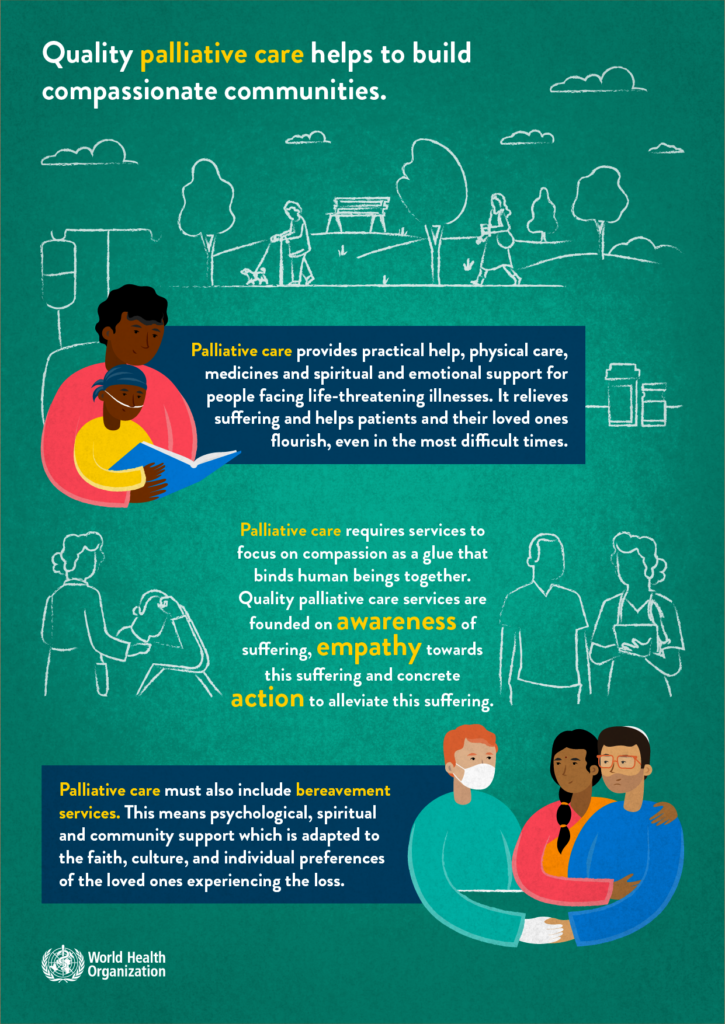
According to the definition by the World Health Organisation, palliative care is the active total care of patients whose disease is not responsive to curative treatment .Control of pain, of other symptoms and psychological, social and spiritual problems is paramount. The goal of palliative care is the achievement of the best possible quality of life for patients and their families. Many aspects of palliative care are also applicable earlier in the course of the illness, in conjunction with treatment. Palliative care
- Affirms life and regards dying as a normal process
- Neither hastens nor postpones death
- Provides relief from pain and other distressing symptoms
- Integrates the psychological and spiritual aspects of patients care
- Offers a support system to help patients live as actively as possible until death
- Offers a support system to help the family cope during the patient’s illness and in their own bereavement